Sunday, May 1, 2011

Hermit Crabs(:


HERMIT CRABS!
by Sienna Purse
Classification(:
Kingdom:Animalia
Phylum:Arthropoda
Subphylum:Crustacea
Class:Malacostraca
Order:Decapoda
Infraorder:Anomura
Superfamily:Paguroidea
Latreille, 1802
Anatomy:

Most species have long, spirally curved abdomens which are soft, unlike the hard, calcified abdomens seen in related crustaceans. The vulnerable abdomen is protected from predators by a salvaged empty seashell carried by the hermit crab, into which its whole body can retract. Most frequently hermit crabs use the shells of sea snails (although the shells of bivalves and scaphopods and even hollow pieces of wood and stone are used by some species). The tip of the hermit crab's abdomen is adapted to clasp strongly onto the columella of the snail shell. As the hermit crab grows in size, it has to find a larger shell and abandon the previous one. This habit of living in a second hand shell gives rise to the popular name "hermit crab", by analogy to a hermit who lives alone. A few species do not use a "mobile home" and inhabit immobile structures left bypolychaete worms, vermetid gastropods, corals and sponges.

Form and Function:

Hermit crab species range in size, shape, from species with a carapace only a few millimetres long to Coenobita brevimanus which can approach the size of a coconut. The shell-less hermit crab Birgus Latro (coconut crab) is the world's largest terrestrial invertebrate.

The young develop in stages, with the first two (the nauplius and protozoea) occurring inside the egg. Most hermit crab larvae hatch at the third stage, the zoea. This is a larval stage wherein the crab has several long spines, a long narrow abdomen, and large fringed antennae. After several zoeal moults, this is followed by the final larval stage, the megalops stage.

Impact on Humanity:


Several marine species of hermit crabs are common in the marine aquarium trade. Of the approximately 15 terrestrial species in the world, the following are commonly kept as pets. These omnivorous or herbivorous species can be useful in the household aquarium as scavengers, because they eat algae and debris.
Journal Article Review:
"The unwanted guests of hermits: A global review of the diversity and natural history of hermit crab parasites"

http://cirripedia.myspecies.info/content/unwanted-guests-hermits-global-review-diversity-and-natural-history-hermit-crab-parasites

This article is about the many parasites that a hermit crap can harbor in it's shell. There are about 130-140 species out of the 850 species of hermit crabs that are parasitized. This article goes on to talk about ways of parasitization and how we underestimate hermit crabs importance.


Works Cited:

McDermott, JJ, Williams, JD, & Boyko, CB. (2010). The unwanted guests of hermits: a global review of the diversity and natural history of hermit crab parasites.Journal of Experimental Marine Biology and Ecology,394. Retrieved from http://cirripedia.myspecies.info/content/unwanted-guests-hermits-global-review-diversity-and-natural-history-hermit-crab-parasites


Hermit crab anatomy. (n.d.). Retrieved from http://www.hermitcrabpatch.com/Hermit-Crab-Anatomy-a/136.htm


Hermit crab lovers. (n.d.). Retrieved from http://www.hermit-crabs.com/

Lovebug by jacque prado :)


(Figure 1)
I. Introduction

Classification:

Kingddom: Animalia

Phylum: Arthropoda

Class: Insecta

Order: Diptera

Family: Bibionidae

Genus: Plecia

Species: P. nearctica

Plecia nearctica, the lovebug, is also known as the kissingbug, double-headedbug, or the honeymoon fly. There is a myth that lovebugs were genetically engineered at the University of Florida; this is false. The truth is they migrated from Central America to southeastern United States. The reason for the migration is unknown. They are weak flyers and have only two major flights a year that occur in late spring and then again in the late summer. The altitudes of their flights can reach from 980 feet to 1,480 feet.


II. Anatomy

Plecia nearctica have smoky colored wings and a red-orange thorax with a velvety appearance. Males are about 1/4 inch long and weigh about 6-10 mg, while f

emales are 1/3 inch long and weigh about 15-25 mg. The weight difference between the two is because of the females’ ovaries which hold 70% of her total protein. Neither are able to store lipids in their fat body cells.


10. 9th abdominal segment and associated

structures in P. americana

11. 9th abdominal segment

and associated structures in P. nearctica

12. 9th tergum of P. americana

13. 9th tergum of P. nearctica

14. 9th sternum with left telomere in P. americana

15. 9th sternum with left telomere in P. nearctica

(Figure 2)


III. Form and Function:

Lovebug larvae (which have chewing mouth parts) tend to live off decomposing plants and cow manure while the adults feed on the nectar of flowers. Females only live for about 3-4 days while males live a little longer. They only come out during the day while the temperature is above 68Fwhile at night they sleep on low-growing vegetation. During mating, the males hover in the air while the females crawl up the vegetation. The females are grasped by the males either off of the vegetation or during flight. They fall to the ground where they “couple” and at first the male is positioned on the back of the female and they both face the same direction. The male then turns 180° to face the opposite direction. Genitalic engagement takes about 1.5 minutes to 10 minutes. There is great competition for females and hovering males may attempt to disrupt mating pairs. The average eggs per female are about 350 eggs and they lay their eggs in moist dam

p areas. Adult are prey to spiders and cars, while birds are the predators to lovebug larvae.

(Figure 3)


IV. Impact on Humanity: (Figure 4)

Plecia nearctica do not bite nor transmit any diseases. Their larval stages are beneficial by helping recycling the decaying vegetative matter into organic matter. Adults are considered a nuisance to drivers. Lovebugs are attracted to the formaldehyde that is found in exhaust fumes. They migrate towards intersections, traffic lights, truck stops, and highways because of this. Once they splatter onto the cars, the females do the most damage. This is because they are full of eggs, and the lipids in the eggs bond to the finish of the car and their body fluids are a bit acidic. They also can cause cars to overheat by clogging radiator fans.


V. Journal Article Review

This journal article talks about how lovebugs are back in season. How they are damaging cars, bothering people at the gas pumps, and how uneducated people are about them. People still believe that lovebugs were genetically engineered at the University of Florida to get rid of mosquitoes. This is very untrue and The University of Florida does not take credit for doing so. People also still believe that once the lovebugs are attached, they can never un-attach. But while they do eat away at the car paint, they also eat away at the decaying plant matter.

http://www.abcactionnews.com/dpp/lifestyle/features/no-love-for-love-bugs-in-bay-area

Works Cited

Davis, Rachel. "LOVEBUGS: How Much Do We Really Know about These Many Splattered Things? | Jacksonville.com." Jacksonville News, Sports and Entertainment | Jacksonville.com. Web. 01 May 2011. <http://jacksonville.com/tu-online/stories/052107/lif_170893700.shtml>.

"Love Bugs (Plecia Nearctica)." Aggie Horticulture. Web. 01 May 2011. <http://aggie-horticulture.tamu.edu/newsletters/hortupdate/hortupdate_archives/2006/sept06/LoveBgs.html>.

"Lovebug - Plecia Nearctica Hardy." UNIVERSITY OF FLORIDA ENTOMOLOGY AND NEMATOLOGY DEPARTMENT. Web. 01 May 2011. <http://entnemdept.ufl.edu/creatures/misc/lovebug.htm#econ>.

"Lovebug." Entomology at Texas A&M University - Home. Web. 01 May 2011. <http://insects.tamu.edu/fieldguide/bimg216.html>.

"Lovebug." Wikipedia, the Free Encyclopedia. Web. 01 May 2011. <http://en.wikipedia.org/wiki/Plecia_nearctica>.

"LOVEBUGS." Entomology at Texas A&M University - Home. Web. 01 May 2011. <http://entowww.tamu.edu/extension/bulletins/uc/uc-009.html>.

Tiegen, Alex. "The Truth about Lovebugs | Gainesville.com." Gainesville.com Gainesville FL News, Sports, Weather and More | Gainesville.com | The Gainesville Sun. Web. 01 May 2011. <http://www.gainesville.com/article/20070529/DAYBREAK/705290320?tc=ar>.

Pictures:

Figure 1: http://en.wikipedia.org/wiki/Lovebugs

Figure 2: http://entnemdept.ufl.edu/creatures/misc/lovebug09.htm

Figure 3: http://www.entomology.ucr.edu/ebeling/figures/fig322.jpg

Figure 4: http://entnemdept.ufl.edu/creatures/misc/lovebug11.htm

The Leafy Sea Dragon By Zach

Introduction: The Leafy Sea Dragon is a marine fish which is found in the family of Syngnathidae. Sea Horses also belong to this family. It is called the Leafy Sea Dragon because its shape resembles that of a mythical dragon, and because of the leafy projections that stem out of its body. The average lifespan is quite long, about 5-10 years. If you want to want to find one of these intricate animals you are going to have to travel to the Southern and Western coasts of Australia.

Anatomy: (searched for a half hour for a labeled diagram so here’s a picture with the main body parts defined)

Leaf Projections: The Leaf Projections stemming off of the Sea Dragon are not used for propulsion, but for camouflage. When they swim, the projections give them the allusion of floating seaweed. The Sea Dragon is able to change its body color according to its environment, but this depends of there age, diet, stress, and other factors.

Snout: The Sea Dragon has a long, pipe-like snout that it uses to eat. It has no teeth, so it uses the snout to suck up its prey, just like a seahorse or pipefish.

Pectoral and Dorsal Fin: The Sea Dragon uses both the pectoral and dorsal fin to swim. The pectoral fin is found on the ridge of its neck, and the dorsal is found closer to the end of the tail.

Tail: Unlike seahorses, the Sea Dragon cannot use its tail to grab or hold onto surfaces. It does not have a main purpose.


Form and Function: The Leafy Sea Dragon is a carnivore, and dines on small invertebrates such as shrimp, zooplankton, and larval fishes. It uses its snout to suck up small amounts of water, which contains its food. It needs to eat constantly, and because of this, is sucking in water most of the time. Using their two fins they are able to steer when they swim, and are even able to stay suspended in one spot. They have been recorded to stay in one spot for 68 hours, and can swim at speeds of 150 meters per hour!

Reproduction: Just like their seahorse relatives, the males care for the eggs until they hatch. Once the female produces the eggs, about 250 in all, she places them on the male’s tale, via a long tube. The eggs attach themselves to a brood patch so they can receive oxygen. It takes approximately 9 weeks for the eggs to hatch. During the 9 week period the eggs turn from pink to purple or orange. Only 5% of the eggs survive to hatch.

Impact on world/humanity: There is not enough known on Leafy Sea Dragons to have an impact on the world, but they are still kept in aquariums where they are researched to hopefully find an impact.

Journal/Article Review: http://aem.asm.org/cgi/content/short/72/1/284
This article is about how scientist found Epitheliocystis, also known as Chlamydiales bacteria, in Leafy Sea Dragons. Epitheliocytis is found in some fresh and salt water fish, and has recently been discovered in the gills of the Leafy Sea Dragon. If infection is considerable there is an increase in mucus around gills, fish becomes very tired and breathes rapidly. The mortality can be severe. The Leafy Sea Dragon is already near threatedof, and so an infection such as Epitheliocystis could be devastating to their population, especially since there is no cure or even treatment. (The article is very hard to understand)

Bibliography: (APA)
Wikipedia, Initials. (2006, May 11). Leafy sea dragon . Retrieved from http://en.wikipedia.org/wiki/Leafy_sea_dragon

Dive Gallery, Initials. (2004, October 6). Leafy sea dragon . Retrieved from http://divegallery.com/Leafy_Sea_Dragon.htm

New England Aquarium, Initials. (2008, July 18). Leafy seadragon . Retrieved from http://www.neaq.org/animals_and_exhibits/animals/sea_dragons/index.php

Saturday, April 30, 2011

Queen Scallop!


The Queen Scallop!

By Connie Gould

Introduction

Classification:

Kingdom: Animalia

Phylum: Mollusca

Class: Bivalvia

Order: Ostreoida

Family: Pectinidae

Genus: Aequipecten

Species: A. opercularis

Introduction

A. opercularis, or, by its common name, the queen scallop, is most commonly found at the bottoms of seas and oceans, except in rocky areas. They can live at depths of 1,312 feet, but are most commonly found at depths of about 130 feet. They are found in the Mediterranean Sea and East Atlantic coast, and are commonly found in bodies of water surrounding areas from Norway to the Cape Verde Islands, and are raised on experimental farms in Spain, France, and the U.K. As a species, the queen scallop is not considered threatened or endangered.

Anatomy

The queen scallop possesses two laterally located valves, or shells, characteristic of their class. The valves are flat and round, and 20 ribs extend out from the umbo. Small, winglike extensions that are unequal in size are found on either side of the umbo. The color of their shell varies; the color can be either spotted or solid, and white red and orange are the most common colors. The right valve is typically lighter in color than the left, and the inside of both valves is white. The edge of the mantle possesses many sensitive tentacles that have eyes. They are typically around 7 cm in size, and therefore are one of the smaller species of scallop that is exploited by humans.

Form and Function

The queen scallop’s diet consists of plankton and other tiny plants and animals floating in the water. They are suspension feeders, which means they depend on ciliary currents produced by their gills to get their food. Gland cells on the gills secrete large amounts of mucus, which captures food particles suspended in the water. Ciliary tracts then move the particles to the mouth. In the stomach, a crystalline style keeps the food particles moving, enzymes for extracellular digestion dissolving off of the rod as it rotates. Particles are then directed to the digestive gland, where they undergo intracellular digestion. The two valves of a queen scallop are located laterally (at the sides), and are held together by a hinge ligament. Adductor muscles draw the valves together. Above the hinge ligament is the umbo, the oldest part of the shell. Their valves are primarily used for protection against predators. Predators include sea stars, gastropods, and cephalopods. Their visceral mass is suspended from the dorsal midline, and they have a muscular foot that connects to the visceral mass. Queen scallops have a three-chambered heart that pumps blood through the gills and mantle for oxygenation. The heart also pumps blood to the kidneys for the excretion of waste. The queen scallop can escape danger by “swimming.” It extends its muscular foot, and blood is pumped into the foot, resulting in a swelling that allows the foot to act as an anchor. Longitudinal muscles contract to pull the scallop forward. Queen scallops are monoecious (hermaphroditic); they start their life as males and their gender changes over time. For reproduction, they release spermatozoids and eggs into the water during mating season, and fertilization takes place.

Impact on the World/Humanity

Queen scallops are of great economic importance. They are raised in commercial fisheries most commonly in countries in western Europe, and are frequently found on the menu in upscale restaurants. They are an important part of the marine food web, as they are eaten by cephalopods, which are also a source of food for humans. The queen scallop’s colourful valves can also be worn as jewelry.

Journal Article Review

The Isle of Man Government’s Fisheries Directorate has earned first place at the U.K. finals of the Sustainable Seafood Awards 2011. The award is of great prestige, as it means that the Isle of Man Queen Scallop Fishing Industry manages to produce world class products while protecting the animal as a species. John Shimmin, minister for the department, said: “It is gratifying to receive this type of recognition of our efforts.” The Isle of Man Queen Scallop Fishing Industry fishes only mature queen scallops, ensuring that the younger stock remains on the seabed, repopulating the waters for future years, and preventing the endangerment and overfishing of the species.

Article Source: http://www.fishupdate.com/news/fullstory.php/aid/14784/Island_Queen_Scallop_Industry_wins_Sustainable_Seafood_Awards_2011.html

Videos

http://www.youtube.com/watch?v=vmi_I8QW5eo

http://www.youtube.com/watch?v=RrCKsch9c1k&feature=related

http://www.youtube.com/watch?v=RyYKZgz7lEw&feature=related

Sources

"Bivalves: Bivalvia - Queen Scallop." Web. 30 Apr. 2011. .

Hickman, Cleveland P. "Molluscs." Animal Diversity. Boston: McGraw-Hill Higher Education, 2009. 192-96. Print.

"Queen Scallop." Wikipedia. Web. 30 Apr. 2011. .

Friday, April 29, 2011

Lycosa Furcillata: The Wolf Spider

Lycosa Furcillata


Figure 1. (above and below) The Lycosa Furcillata

I. Introduction
Kingdom: Animalia
Phylum: Arthropoda
Class: Arachnida
Order: Araneae
Superfamily: Lycosoidea
Family: Lycosidae
Genus: Lycosa
Species: furcillata

Lycosa furcillata is one of the many species of wolf spiders that we commonly find in our homes. There are over 2,000 species of spiders that carry the common name ‘wolf spider’. Wolf spiders belong to the family Lycosidae. In Ancient Greek, the word "λύκος" is translated as “wolf” and these spiders earn their name because they actively hunt down their prey. They always look like they’re on the prowl because their bodies remain low to the ground at all times. But don’t be fooled, even though they carry the name wolf, they are still very shy and scurry away at the slightest disturbance.
The Lycosa furcillata can be commonly found in gardens, homes, in leaf litter, areas of tall grass, or under stones and logs (as can be seen in figure 2).


Figure 2. A lycosae hiding in the brush.

II. Anatomy
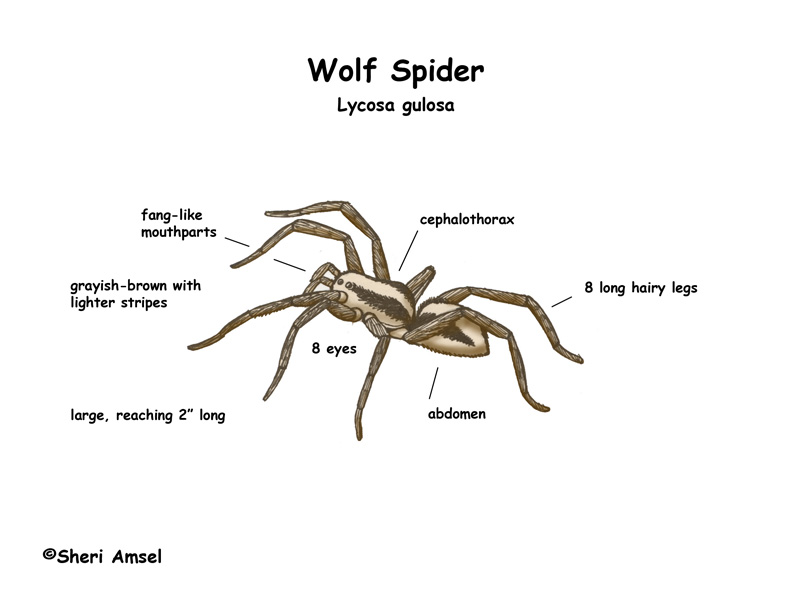
Lycosa furcillata ranges from half an inch to two inches in length. They tend to be brown and grayish in color. They have eight eyes in all which are arranged in three rows; four on the bottom and two in the middle and on top. They are very hairy and they use their hairs to sense the environment. The wolf spider has a cephalothorax and a large abdomen.


Figure 3. Simple anatomy of a wolf spider


III. Form and Function
The wolf spider, unlike most spiders, actively hunts its prey. They have excellent vision (for a spider) and hunt well in the night and in the day. Their gray and drab coloring helps them to camouflage. Not only do they have good eyesight but they also have a good sense of touch from the multiple small hairs that cover their body, their setae. Lycosa furcillata are opportunistic feeders and feed on animals ranging cockroaches, mealworms, crickets, and small lizards.


Figure 4. A wolf spider feeding


The spider either ambushes or hunts its prey. They’ve been known to chase down their prey for short distances. They grab their prey with their front legs and bite down with their vicious jaws, or chelicerae. Their chelicerae crush the victim and venom is injected. The venom reduces the innards of the prey into a gooey liquid. The spider sucks the liquid and leaves a shriveled husk. There are cases in which wolf spiders commit “superfluous killing” where they spider kills multiple times and abandons the bodies. It is believed that this behavior is a sort of population control on the prey species.
The Lycosa furcillata is also prey to a vast range of predators; owls, coyotes, lizards, and many predatory insects. There is a type of wasp whose sting paralyzes the wolf spider. The wasp then lays its eggs into the wolf spider’s body where the baby wasps will hatch and eat the spider alive.
Reproduction can be a tricky business for males. Mating season generally occurs during spring and summer. The male will approach the female tentatively and engage her in an intricate courtship dance. If the male doesn’t make known his intentions, then the female could eat him for a meal.


Figure 5. A male starting his ritualistic courtship dance.


The female, once impregnated, will lay up to one hundred eggs in a secluded spot. However, unlike most spiders she creates a silk sac which she uses to encase the eggs. She attaches the egg sack to her abdomen, specifically her spinnerets. She defends her eggs and babies with her life. In two to three weeks the mom will take off the egg sac and rip it open. Baby spiders swarm out and clamber on top of the mom’s abdomen. They’ll remain there until their first molt. Throughout this the mother doesn’t change her hunting patterns. The young don’t feed while on their mom but they do drink dewdrops. The average life span of the Lycosa furcillata is about two years.


Figure 6. A female Lycosa furcillata with her egg sac.


Figure 7. A mother with her babies.


Unlike other animals, the spider excretes digestive enzymes in its venom. The spider has tiny hairs around and in the mouth which filters the liquefied guts. The nutrition then enters the sucking stomach and into the midgut. In the midgut, the meal is furthered digested into manageable molecules. At the end of the midgut there is a cloacal chamber where the fecal matter is stored. The fecal matter will later be expelled.


IV. Impact on the World

Lycosa furcillata and humans can easily come in close contact in Florida, especially when the spider enters into our homes. The spider only bites when handled or provoked. It does produce venom, however, the bite is only slightly painful and there are no long lasting repercussions. Other than this, the wolf spider can be very beneficial to humans because the spider can control pest populations in agriculture and home areas.


Figure 8. Wolf spider


V. Journal Article

Unfortunately, I was unable to find an article specifically on the Lycosa furcillata but I did find a super awesome article on another wolf spider.
A scientist did a study on certain chemicals that prey can pick up on that occur during feeding habits of the Hogna helluo. There were three sheets of blank paper. On one of the sheets a Hogna helluo hunted down and devoured the wolf spider Pardosa milvina. On another sheet, the Hogna helluo devoured crickets and on the third sheet was a blank control where nothing occurred.
There was a significant change in behavior in the P. milvina when on the sheets of paper. On the sheet where the Hogna helluo ate a Pardosa milvina, the living P. milvina stayed still and didn’t move. On the cricket sheet, the P. milvina elicited more activity. And on the blank sheet the P. milvina was most active. If given a choice the P. milvina chose the blank control much more often than the other two sheets where the Hogna hunting had occurred.

I wasn't able to download and upload the video, sorry :(

But it is a really cool video on a Lycosa eating a katydid


Works Cited:


"FAMILY LYCOSIDAE - Wolf Spiders." Www.BrisbaneInsects.com. Web. Apr. 2011. .

Nieuwenhuys, Ed. "Wolf Spiders." XS4ALL - Internet, Bellen, Televisie En Hosting. 2009. Web. Apr. 2011. .

Olli. "Wolf Spider Mating Dance Flickr - Photo Sharing!" Welcome to Flickr - Photo Sharing. Flickr. Web. 29 Apr. 2011. .

"There Are about 40,000 Kinds of Spiders." Easygopest.com - Doing It In Just One Visit. Temidor Certified. Web. Apr. 2011. .

"Wolf Spider Lycosa Furcillata Female." Australian Venom Research Unit. Web. Apr. 2011. .

"Wolf Spider." Spider Bites. Bad Spider Bites.com. Web. Apr. 2011. .

"Wolf Spider." Wikipedia, the Free Encyclopedia. Wiki. Web. Apr. 2011. .

"Wolf Spiders." Entomology & Plant Pathology, Division of Agricultural Sciences and Natural Resources. Web. Apr. 2011. .

"Wolf Spiders (Lycosidae)." Green Nature. Web. Apr. 2011. .